
Protected Forever: What State Dedication Means for Jackson-Schnyder
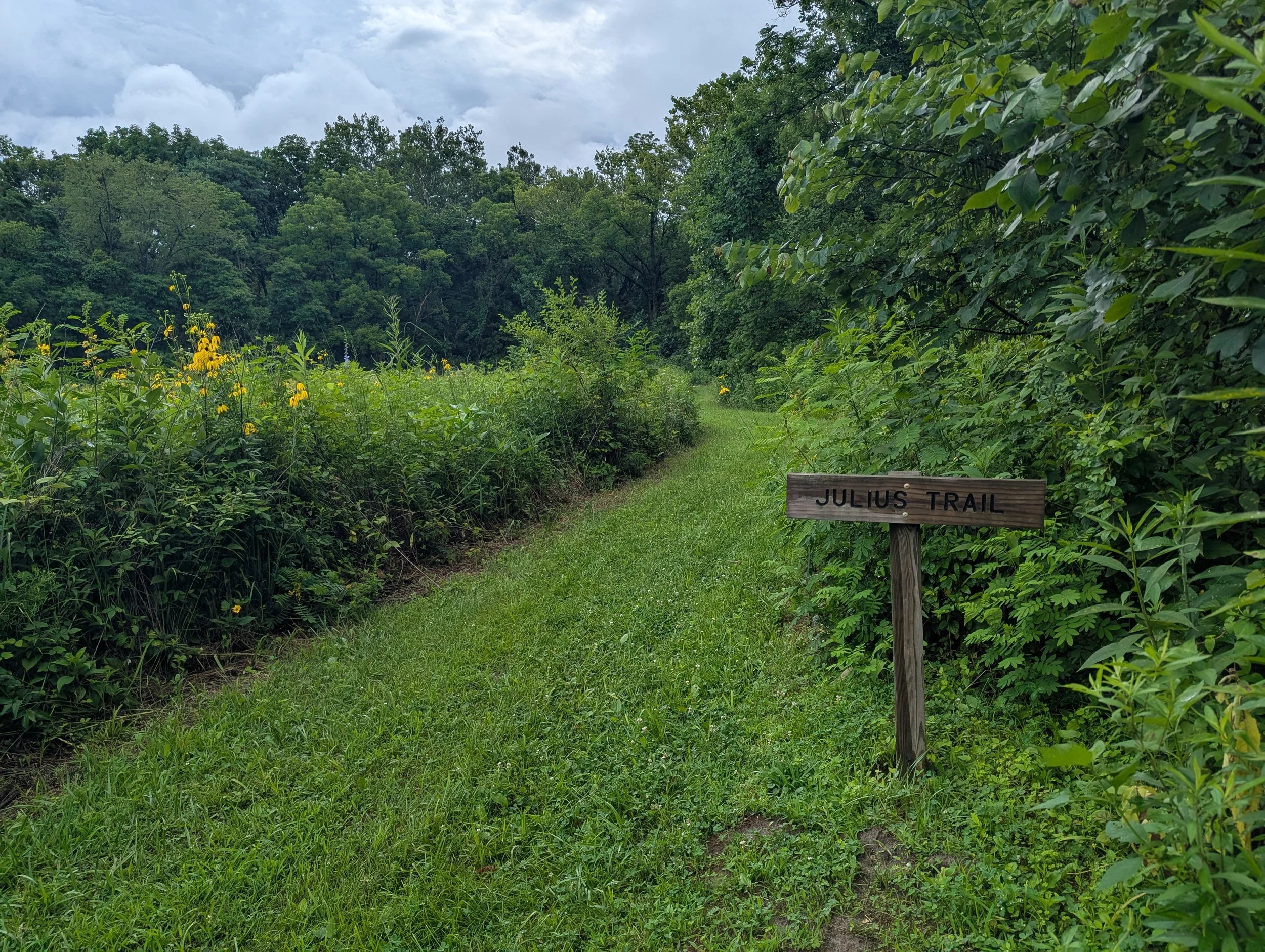
Jackson-Schnyder Nature Preserve offers a glimpse of the forests, wildflowers and wildlife communities that once characterized much of Indiana and state dedication helps ensure that glimpse will remain available to future generations.
Stand beneath the mature trees at Jackson-Schnyder Nature Preserve, and the landscape begins to tell a story.
Deep ravines cut through the approximately 20-acre property. Spring wildflowers spread across a forest floor that has experienced little disturbance. A restored prairie borders the woods, while Little Sugar Creek adds habitat and scenic beauty along the preserve’s edge.
For Ron Hellmich, assistant director for public lands with the Indiana Department of Natural Resources’ Division of Fish, Wildlife and Nature Preserves, the message for first-time visitors is simple.
“This area is what old Indiana used to be,” Hellmich said. “We are just visitors to the place, and many other species call it home.”
Indiana’s Highest Level of Protection
Indiana established its nature-preserve system through the Nature Preserves Act of 1967. The state’s first dedicated preserve, Pine Hills Nature Preserve at Shades State Park, followed in 1969.
A state-dedicated nature preserve is land formally accepted into the system by the Indiana DNR because of its ecological, geological, scenic or scientific importance. Dedication recognizes preservation as the property’s highest and best use for the public benefit.
A qualifying property may contain a natural community resembling Indiana before widespread settlement and development, or it may protect unusual plants, animals, geological formations, fossils or scenic features.
The land does not have to be owned by the state. Cities, counties, universities, nonprofit organizations and private landowners may retain ownership while voluntarily dedicating qualifying land.
That distinction is important at Jackson-Schnyder. Ouabache Land Conservancy owns the property and protects it through its private-property rights. State dedication adds a second, statutory layer of protection.
“It adds another layer of protection on the area,” Hellmich said.
A Voluntary but Rigorous Process
No property becomes a state-dedicated nature preserve without the landowner’s full agreement.
The process often begins when a land trust or another conservation partner believes a property may be ecologically significant. DNR ecologists then visit the site to examine its natural communities, plant and animal life, rare species, past disturbances and overall ecological condition.
They consider both the landscape as a whole and its finer details: What belongs there? What is missing? How much disturbance has occurred? Does the property retain the characteristics of a functioning natural community?
If DNR determines that the land is nature-preserve quality, the agency and landowner develop a master plan addressing its long-term protection, management and appropriate uses. The dedication proposal is then presented to the Indiana Natural Resources Commission for acceptance.
Once the legal documents are completed and recorded, the dedication remains attached to the property.
Why Jackson-Schnyder Stands Out
Jackson-Schnyder’s value does not rest on a single tree, wildflower or scenic view. Its significance comes from the way its many natural features work together.
The property’s forested areas are believed to have gone without logging for more than a century under the ownership of the Schnyder family and, later, Indiana State University professor Marion Jackson. The large, mature trees provide evidence of the forest’s age, while its abundant spring wildflowers indicate that the forest floor has remained relatively intact.
“If the wildflowers weren’t there, we’d have to consider why,” Hellmich said.
The deep ravines, varied elevations, Little Sugar Creek frontage, prairie and old-growth forest collectively create habitat for insects, birds, mammals, reptiles, amphibians and plants. The view overlooking the creek adds scenic value, but Hellmich said it is the entire ecological picture that makes the property worthy of dedication.
“It is all of that. Taken altogether, it makes it worthy of nature-preserve status,” he said.
The preserve is an example of a forest community that characterized this part of Indiana for thousands of years. In that sense, it is both a refuge for wildlife and a living record of the region’s natural history.
Why Nature Cannot Simply Be Rebuilt
Trees can be planted. Prairies can be seeded. Wetlands and forests can be restored. Yet restoration rarely reproduces every relationship present in an established natural community. A newly planted woodland may eventually develop a tree canopy, but it may lack the spring wildflowers, fungi, soil organisms, and specialized insects found in an older, intact forest. Without a nearby natural area to supply those missing components, some may never return.
Hellmich compared the loss of species and ecological relationships to removing pieces from a Jenga tower. The structure may remain standing for a while, but no one knows which missing piece will finally cause it to fall. A disappearing wildflower may appear insignificant by itself. However, its loss could affect a native bee or moth that depends upon it. The loss of that pollinator could then affect another plant, animal or food source. “We sometimes don’t know what the cascading events are,” Hellmich said.
Technology cannot easily replace those relationships because people do not yet understand every process occurring within a functioning ecosystem. Protecting an intact natural area preserves not only the species scientists recognize today, but also relationships and organisms that have not yet been fully studied.
Small Preserves Still Matter
Conservationists generally prefer larger protected areas because they can support greater ecological diversity and withstand more pressure from development, invasive species, and other outside influences. Size, however, is not the only measure of importance. A small preserve may protect the last surviving example of a natural community in its part of the state.
Jackson-Schnyder is especially valuable because an old forest survives so close to an urban area. It gives Vigo County residents a place to walk beneath mature trees, observe wildlife, relax and experience a landscape that would otherwise be easy to lose. “Though small, it still provides habitat for many species. Insects, birds, mammals, reptiles, amphibians, and plants all call this place home,” Hellmich explained.
Protection Requires a Light Touch
Nature-preserve designation does not necessarily mean leaving a property entirely alone.
Earlier generations of conservationists sometimes believed that once land was protected, human involvement should end. Experience has shown that approach is not always enough. Invasive plants continue to spread, natural fire cycles have been interrupted and trails require maintenance if visitors are to use them without damaging sensitive areas.
Prescribed fire may be needed to sustain prairie communities. Invasive-species removal can prevent nonnative plants from overwhelming native wildflowers and tree seedlings. Prairie restoration, erosion control and carefully planned trail maintenance can help a preserve remain healthy. The objective is not to control every aspect of the landscape. It is to recreate necessary ecological processes when possible while avoiding unnecessary disturbance. “A light touch is best,” Hellmich said.
Welcoming People While Protecting Nature
Within a dedicated nature preserve, protection of natural features comes first. Public access is allowed only when it can occur without degrading the resources that justified dedication.
Jackson-Schnyder had a long educational history before it entered the nature-preserve system. Marion Jackson used the property as an outdoor laboratory for Indiana State University students and learners of all ages. That established educational purpose was considered when the property was dedicated.
OLC continues that tradition today. The preserve has publicly accessible trails through its woods and prairie, and it remains a place where community members and university students can study forests, wildlife, restoration and land stewardship. “Being able to take students out to a natural area allows them to explore and learn about our natural world,” Hellmich said.
A Partnership Built for the Future
Jackson donated the property to the newly formed Ouabache Land Conservancy in 2009. That gift preserved the land, but it also demonstrated why local land trusts are essential to Indiana’s nature-preserve system.
The Nature Preserves Act was designed to encourage partnerships. State agencies cannot identify, acquire or care for every significant natural area on their own. Local land trusts bring relationships, regional knowledge and an understanding of community needs that a statewide agency cannot easily duplicate. They can also respond quickly when conservation opportunities arise. “A land trust can be sensitive to local needs and much more nimble in conservation action and advocacy,” Hellmich added.
At Jackson-Schnyder, DNR provides guidance on natural-area management, while OLC oversees day-to-day stewardship and serves as the “boots on the ground.” As long as its work follows the preserve’s master plan, OLC can manage invasive species, care for trails, conduct restoration and respond to new challenges. DNR remains available to help evaluate problems and develop solutions.
Volunteers, members and donors make that stewardship possible. They are part of a conservation story that began long before the property was donated. The Schnyder family and Marion Jackson protected the forest through decades when it might otherwise have been logged or developed. OLC’s supporters now carry that responsibility forward.
“The nature-preserve system is more than just the nature preserves,” Hellmich said. “These places could not exist, be protected and be protected into the future without volunteers and organizations like OLC.”
What “Permanent” Protection Means
State dedication creates a legally protected interest in the property and establishes preservation as its highest and best use. Converting the land to another purpose would require an “imperative and unavoidable public necessity” an exceptionally high standard. That protection is significant because private property, including land owned by a nonprofit organization, can ordinarily be affected by condemnation or eminent domain for public projects. State dedication creates a powerful additional barrier against those actions.
OLC continues to own Jackson-Schnyder, but the land’s dedication is intended to endure beyond changes in organizational leadership, neighboring development or future public projects. It is a promise not only to current visitors, but also to people who may walk beneath these trees generations from now.
Other State-Protected Nature Preserves in Vigo County
In addition to Jackson-Schnyder, Hellmich identified four state-protected nature preserves in Vigo County. Indiana DNR’s online directory primarily lists preserves open for public visitation, so restricted properties may not appear in its public-facing list. Always confirm access before visiting.
John G. Dobbs Memorial Nature Preserve
Located within Dobbs Memorial Park on Terre Haute’s east side, this 25-acre preserve is owned by the Terre Haute Parks and Recreation Board. Its varied elevations support a notable diversity of trees and other plant species. Parking, trails and the Dobbs Park Nature Center provide opportunities for public education and exploration.
Learn more from Indiana DNR.
Elliott Woods Nature Preserve
Elliott Woods is located within Prairie Creek Park in southern Vigo County and is managed by Vigo County Parks and Recreation. The 80-acre woodland was added to the park system in 2000 and offers trails, solitude and opportunities for immersion in a mature forest setting.
Learn more from Vigo County Parks.
R. Kermit Flesher Memorial State Nature Preserve
This county-owned preserve protects a distinctive floodplain forest in southwestern Vigo County. It does not have routine public access; entry is allowed only with permission from Vigo County Parks and Recreation.
View the county’s preserve information.
Little Bluestem Prairie Nature Preserve
Owned by Indiana State University, this restricted preserve protects a small remnant of the sand prairie that once occurred north of Terre Haute. Research has documented approximately six acres of protected prairie habitat. The property is not open for routine public visitation, and permission should be obtained before any visit.
Public access varies by property. Visitors should remain on designated trails, follow posted rules and never remove plants, wildlife, rocks or other natural materials from a preserve.