
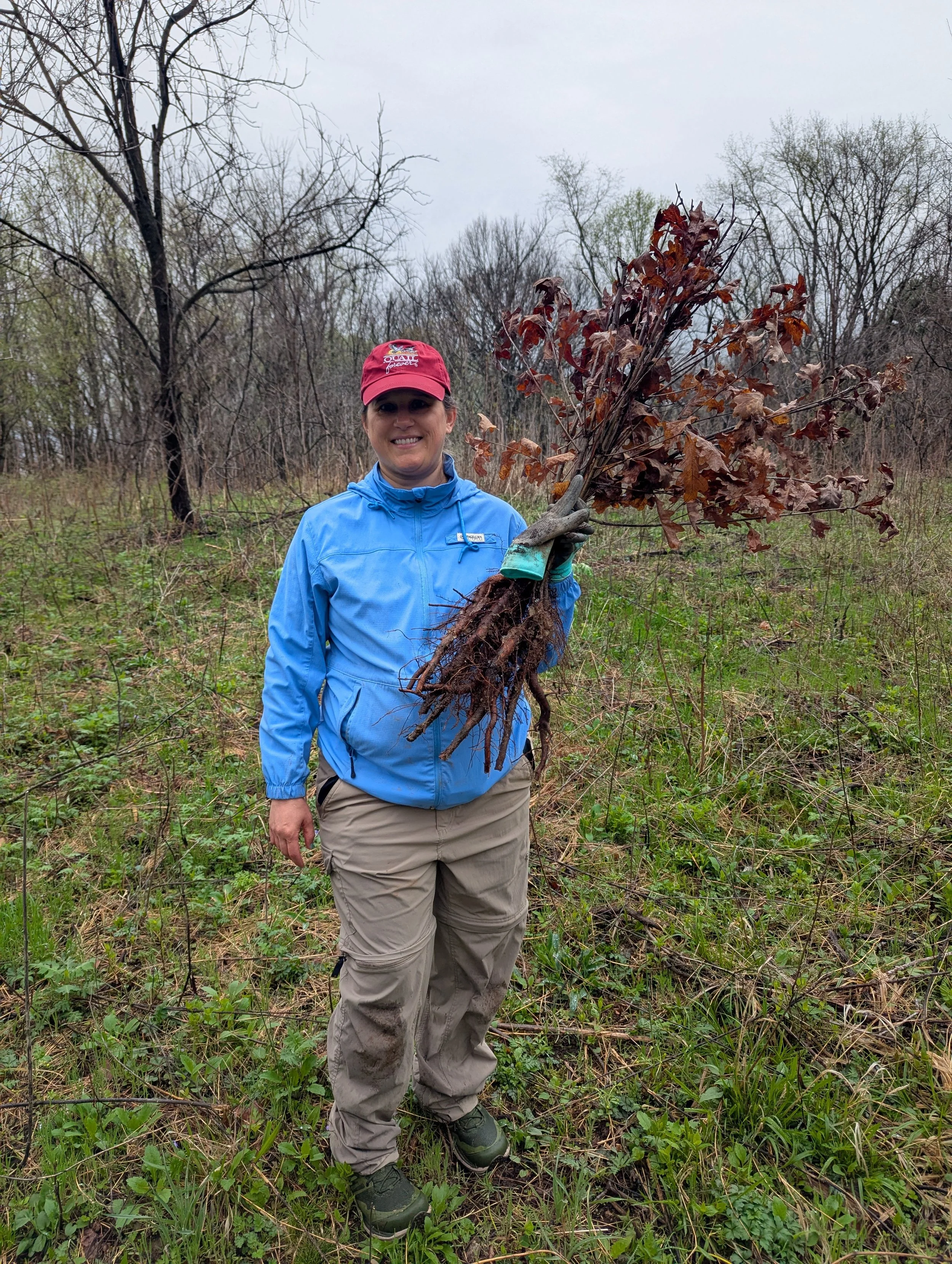
On Easter Eve, with muddy boots, steady hands, and a shared sense of purpose, volunteers with the Ouabache Land Conservancy planted 400 oak saplings at Atherton Island Natural Area, an effort rooted in restoration, resilience, and renewal.
A Community Effort Takes Root
What began as an ambitious goal quickly transformed into a celebration of community action. Volunteers from across the region, Curt, Laurie, Mike, Jami, Dick, Jane, Andrew, Samantha, Phil, and others, came together to tackle what initially felt like a daunting task.
“Well, thanks to Phil Cox, as always, we were able to have a well-organized tree planting event. “As with most things at Ouabache Land Conservancy, we’re able to realize great accomplishments because we have so many volunteers who help us reach our goals,” OLC Board Member Jim Nardi said.
Nardi admitted expectations were modest leading up to the event. “Phil and I were worried that we were only going to have three or four people, and look at the turnout,” Nardi remarked. Instead, the site filled with energy and purpose as volunteers worked together to bring new life to the landscape.
A Carefully Planned “Treasure Hunt”
For those arriving on-site, the experience came with a lighthearted twist, what some jokingly called an ‘adult Easter egg hunt’. “We’re looking for wire flags that have been strategically placed by Jim Nardi. Those flags show us exactly where to plant the trees so the oaks have enough sunlight to grow. They can’t grow well in the shade,” OLC Board Member Phil Cox explained.
Each flag marked more than just a planting location; it represented careful planning, ensuring each sapling had the best possible chance to thrive.
Restoring an Oak-Hickory Legacy
The effort was about more than planting trees; it was about restoring a forest ecosystem that once defined the area. “The goal today was to resurrect the oak-hickory forest here at Atherton Island that probably existed over a hundred years ago. And it’s an appropriate thing to do on Easter weekend, to resurrect a forest,” Nardi explained.
Volunteers planted both white oak and black oak saplings, species chosen for their ecological importance and historical presence.
“We planted strictly oaks—white oaks and black oaks. Oaks are crucial for the ecology of a woodland,” Nardi said.
The Science Behind the Work
The planting effort followed months of preparation and land management work designed to support long-term forest health.
“The reason we have these openings out here now is because we had a forest stand improvement project. That thinning allows more oaks for wildlife like turkey, deer, and songbirds that eat caterpillars. And those caterpillars depend on oak trees—it’s all part of the food chain,” Cox explained.
The work was supported through the Environmental Quality Incentives Program, a federal initiative that helps land managers improve natural areas. “It’s a USDA cost-share program for land improvement and stewardship of natural areas. We applied for invasive species removal and forest stand improvement here at Atherton Island. That work was completed late last year, and now it’s opened the door for us to come in and plant,” Cox said.
The saplings were sourced through the Indiana Department of Natural Resources nursery system, ensuring they were well-suited to Indiana’s environment.
Why Oaks Matter
To some, planting trees in an already wooded area might seem unnecessary. But for conservationists, diversity is key. “Diversity is important to nature. The more diversity we have with trees, the more diversity we have with the animals and the wildlife that live in the forest,” Nardi explained. Oaks play a particularly important role. “There are so many large animals, deer, squirrels, turkey, and so many small animals dependent upon oak trees. They are bastions for moths, butterflies, and beetles. For the whole ecology of the forest, this is an improvement,” Nardi said.
Flexibility, Weather, and Volunteers
Like many outdoor efforts, the event required adaptability.
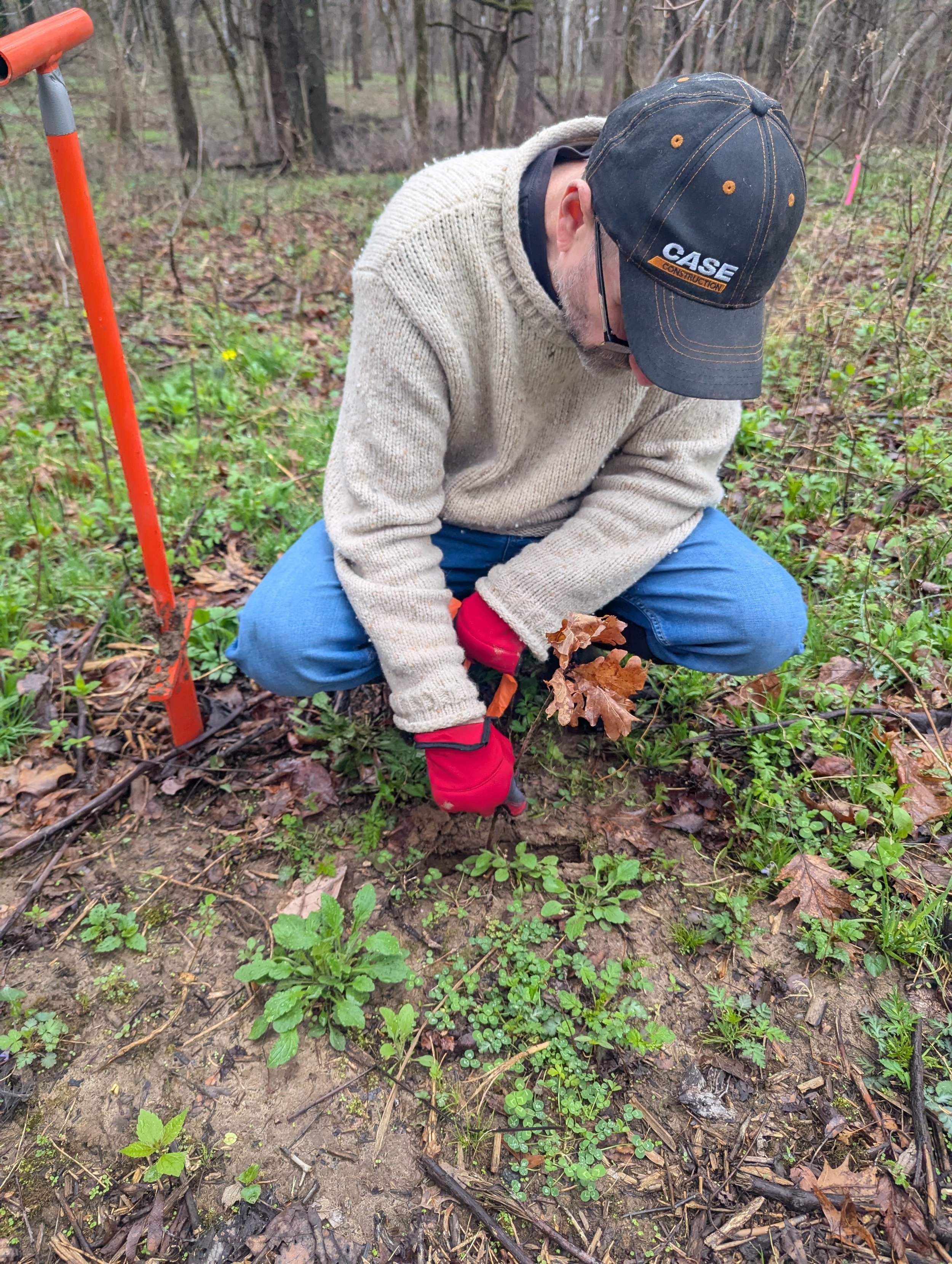
“It was kind of a moving target with the rain. We originally wanted to start at 10 a.m., but we saw the weather was going to clear later, so we shifted to 4 p.m,” Cox said. The change affected attendance, but ultimately, the turnout met the moment. “I think we’ve got nine or ten people here today, and it’s really making the tree planting go a lot faster than if just a couple people were here,” Cox said. And the conditions turned out to be ideal. “I’m wearing a long-sleeve shirt right now, and I’m barely sweating. It’s perfect,” Cox added.
Planting for the Future
Though the saplings are small now, their impact will grow over time. “I think people had fun, and we have a sense of accomplishment. Every time we walk the trails, we can inspect the little oak trees that we planted today and watch them grow over the next years,” Nardi explained.
The experience left a lasting impression on those involved. “It was just a joy to be out with people and to feel that we were accomplishing so much,”Nardi added.
A Call to Keep Growing
For Cox, the day’s success also served as a reminder of what’s needed moving forward. “We need more people to help with OLC and volunteer, and to join OLC. That’s how we’re able to conserve natural resources in West Central Indiana.”
What once felt like an impossible task became something tangible—400 small beginnings planted in the soil, each one carrying the promise of a stronger, more diverse forest. At Atherton Island, the future is already taking root.